


Rococo Style: How it Distincts in Architecture, Furnishings and Painting
Rococo Style: Birth and Development The Rococo, as a reflection of the trends, tastes and way of life of France…




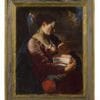


Mid 17th century.
Dimensions: 43x33,5 cm. the painting alone, 48x43 including frame.
“Sleeping Child”, oil on paper applied on panel, Emilian school of the mid-17th century. Contemporary natural wooden frame.
Dimensions: 43×33,5 cm. the painting alone, 48×43 cm. including frame.
Good storage conditions.
On the back, the painting bears an old attribution to the painter Pierfrancesco Cittadini Milan, 1616-Bologna, 1681), but it appears more likely that it is the work of Flaminio Torri (Bologna, 1620-Modena, 1661) and that it is a model on paper (later applied to a wooden board) preparatory for a larger work.
The attribution hypothesis is supported by the comparison of the painting in question with two other paintings by the Bolognese painter, former student of Giacomo Cavedoni and Simone Cantarini, from whom he inherited the workshop together with Lorenzo Pasinelli, paintings of which public domain photos are attached at the end of this post.
The painting in the first photo portrays a "Sarah Family with Musical Angel" and is published with attribution to Torri by Federico Zeri in his photo library.
The second refers, however, to a painting depicting the "Madonna del latte" auctioned at Wannenes on 5 March 2020, lot number 717. Below is the description of the lot made there:
The work bears a traditional attribution to the Bolognese painter Flaminio Torre (Bologna, 1620 – Modena, 1661). In fact, the composition finds very close points of comparison with the canvas already in the P. Lemesle (1823-1912) collection (oil on canvas, 66X50,5 cm - see Pescheteau-Badin, 27 May 2009, n. 113) and, for the single figure of the Virgin with the Child, with the Holy Family and two angels (oil on canvas, 118,5X95 cm, Milan, Porro on 26 May 2004, lot 27). The composition and style show affinity with the influences of neo-Venetian culture and luministic sensibilities of notable naturalistic effect, also anticipating pictorial perceptions of eighteenth-century taste.
Reference Bibliography:
AM Ambrosiani Massari, Flaminio Torre, in The school of Guido Reni, edited by M. Pirondini and E. Negro, Modena 1992, pp. 391-408. fig. 379.
Rococo Style: Birth and Development The Rococo, as a reflection of the trends, tastes and way of life of France…
The Empire style, with its magnificent fusion of majesty and grace, remains an icon of classic furnishings, exerting a timeless charm…
Giò Ponti is one of the artists who most dominated the Italian post-war period, acting as a spokesperson for important innovations in the world…
have viewed this article in the last 30 minutes.