


Rococo Style: How it Distincts in Architecture, Furnishings and Painting
Rococo Style: Birth and Development The Rococo, as a reflection of the trends, tastes and way of life of France…






€2.200,00



early seventeenth century
Oil on canvas, 74 x 56 cm - with frame 80 x 64 cm
Venetian school, 17th century
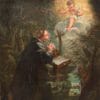
Saint Nicholas of Tolentino in prayer
Oil on canvas, 74 x 56 cm – with frame 80 x 64 cm
On the back it bears the seal of the Venetian Academy of Fine Arts
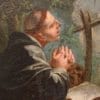
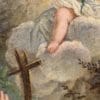
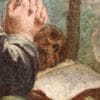
Saint Nicholas of Tolentino (1245-1305), in the canvas analyzed here, is portrayed with the black habit of the Augustinian friars and the tonsure, kneeling in prayer in front of a crucifix made up of two pieces of rough wood. Nicola was born in Sant'Angelo, in the Ancona area, in 1245. At the age of eighteen he became a friar in the Augustinian Order and in 1270 he was ordained a priest. He performed several healings which earned him the reputation of a miracle worker. He settled in Tolentino, a developing center at the time, which led to the intensification and sharpening of political discord. Nicola's presence and his role as a skilled preacher played a fundamental role in mediating the ancient conflict between Guelphs and Ghibellines. Alongside preaching he always dedicated himself to the sick and needy. After thirty years in Tolentino he fell ill and died on 10 September 1305. The Saint is immersed in a lush woodland landscape, the branches of the trees completely cover the surface of the canvas, opening in correspondence with the divine apparition, beneath which flows a clear stream of water. When Nicola was still studying in the Convent of Sant'Angelo, he went to meditate and pray in the countryside immediately below the castle and the Convent, especially going to the ditch still known today as the Fontanelle, which flows at the foot of the large Collechiarino forest. The stories handed down orally over the centuries say that when he arrived near the ditch, he loved to sit on a boulder now placed in the middle of the water, called Sasso Massaccio. It is said that one day, thirsty, the young Nicola, after lying on the ground to rest not far from the stone, miraculously saw water gushing out right where he had rested his head, and in that spot there is now the Fontanelle spring. At the top right is represented the apparition of the Child Jesus, who, supported by a soft cloud and surrounded by a golden light, raises his right hand in a blessing gesture. In his left hand he holds a lily branch, Nicholas' attribute and symbol of purity. The light emanating from the divine apparition illuminates the figure of the saint, forming soft plays of light on the drapery of the dress and reflecting on the surrounding nature. On the rock on which Saint Nicholas is leaning, next to the crucifix, there is the large book of the Rules, a skull, symbol of the "vanity" of earthly things, destined to die, and an hourglass, symbol of the passage of time and the transience of earthly life. The painting in question is rich in naturalistic details investigated with wisdom from both a compositional and chromatic point of view.
With Ars Antiqua it is possible to defer all amounts up to €5.000 at ZERO INTEREST, for a total of 12 INSTALLMENTS.
E.g. Total €4.500 = Monthly installment €375 for 12 months.
E.g. Total €3.600 = Monthly installment €720 for 5 months.
For amounts exceeding €5.000 or for a longer period of time (over 12 installments), we can provide a personalized payment.
Contact us directly to get the best quote.
LIVE TV
– SUNDAY 19.00pm – 23.00pm Dig. terr. 126 – 821 Sky
– Streaming on our website www.arsantiquasrl.com and on our social networks Facebook and Youtube
Rococo Style: Birth and Development The Rococo, as a reflection of the trends, tastes and way of life of France…
The Empire style, with its magnificent fusion of majesty and grace, remains an icon of classic furnishings, exerting a timeless charm…
Giò Ponti is one of the artists who most dominated the Italian post-war period, acting as a spokesperson for important innovations in the world…
€2.200,00
have viewed this article in the last 30 minutes.